

Dr. Amit Sarkar, Houston, Texas, USA
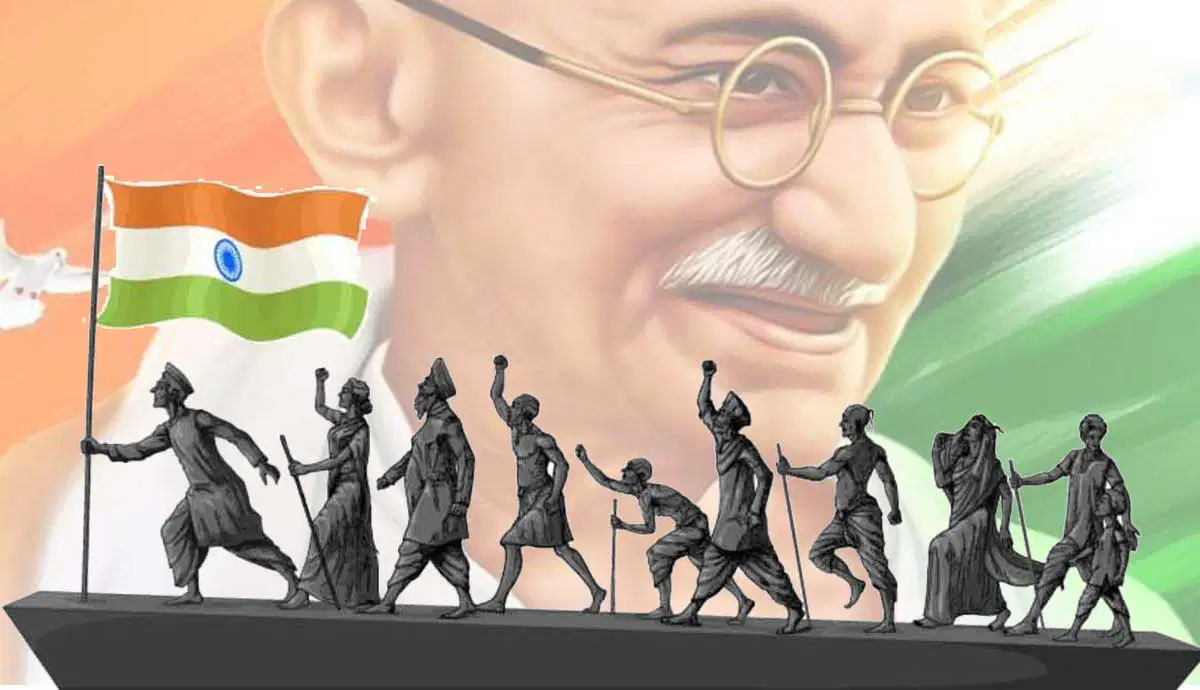
As the year “2026” marks 80 years of Indian independence and 250 years of the USA’s independence, let me begin by paying respect to all the freedom fighters for their dedication and contributions towards the freedom that we all are enjoying today in India and the USA.
A country’s freedom has always been achieved through a long and hard struggle and is never obtained out of compassion of the ruler. The ultimate factor for a ruler leaving is some compulsion, considering the critical military and economic factors, that triggers the decision to leave. So, the perpetual question can be raised again as to:
What exactly triggered the decision of the British Authority in 1946, under the Viceroy Wavell, the Prime Minister Atlee, and King George VI, to leave India?
This article analyzes the published information about the relevant events, actions, and decisions, collected through books and internet searches, emphasizing the last 7 years (1940 to 1947), and presents an original analysis and opinions to bring some clarity to that perpetual question. The British perspective, considering the economic and military factors, was also considered. The 7-year time period is chosen with the fact in mind that it took 7 years for the USA to achieve independence, from 1776 (declaration) to 1783 (peace treaty signing).
Introduction
British rule in India can be divided into two periods: the British East India Company Rule from 1757 to 1857 (Sepoy
Mutiny) and the British Government Rule from 1857 to 1947. The struggle for Freedom from British rule started with the Sanyasi Rebellion (Bengal, 1763-1800), protesting against the oppressive taxation even during the catastrophic Bengal famine, which killed an estimated 10 million people.
Before the post-1857 freedom struggle began, came the Bengal/India renaissance, which started with Raja Rammohan Roy (1772-1833) and Vidyasagar (1820-1891) contributions focusing in the area of social reform, modern education, and free press (1815+). Rishi Bankim Chandra Chatterjee (1838-1894) wrote about the Sannyasi rebellion and the 1176 Bangabdo Bengal famine (Chhiattor-er Monnontor) in his first novel, Anandamath (1882). The novel includes the poem/song “Vande Mataram” (written earlier in 1876) which became the Maha Mantra for all the revolutionaries who dedicated their life for freedom of India. The other renaissance leaders, including Gurudev Rabindra Nath Thakur (18611941), Swami Vivekananda (1863-2002), JC Bose (1858-1937), PC Ray (1861-1944), CR Das (1870-1925), SN Bose (18941974), M Saha (1893-1956), PC Mohalnobis (1893-1972), transformed the Indian society by replacing the rigid outdated traditions with rationalism, liberal humanism and modern education in all spheres of life, including language, philosophy, law, literature, science, and technology. The Renaissance helped strengthen the capabilities and confidence of Indians for Self-Rule in the modern era.
India’s freedom struggle involved significant contributions from both the paths of Military/Armed struggle and the Nonviolence/Non-cooperation/Peaceful protests. The early prominent military struggle organizations include Anushilon Samity (1902) founded by Pramatha Nath Mitra and Satish Chandra Bose, and Jugantar (1906) founded by Aurobindo
Ghosh and Manabendra Nath Roy. The names of the armed struggle leaders include Aurobindo Ghosh (1872-1950),
Barindra Kumar Ghosh (1880-1959), Jatindranath Mukherjee (Bagha Jatin, 1879-1910), Vinayak Damodar Savarkar
(1883-1966), Rash Behari Bose (1886-1945), Khudiram Bose, the youngest revolutionary (1889-1908), Surya Sen (18941934), Subhas Chandra Bose (1897-?), Bhagat Singh (1907-1931), etc. Pritilata Waddedar (1911-1932), the “first woman martyr”, led an armed attack on the racially segregated European club in Chittagong with the racist sign “Dogs and Indians not allowed”. Indian National Congress (established in 1885), which led the non-violence movement, included leaders like, Gopal Krishna Gokhale (1866-1915), Mohandas Karamchand Gandhi (1869-1948), Jawaharlal Nehru (18891964), etc. All-India Muslim League was established in 1906, following the Two-Nation Theory stated by Syed Ahmad Khan in 1888. Muhammad Ali Jinnah (1876-1948) joined the Muslim League in 1913, after being in Congress for 7 years, to focus on Muslim rights and to eventually lead the campaign for the creation of Pakistan.
Khudiram Bose and Prafulla Chaki of the Jugantar group, under the leadership of Aurobindo Ghosh, carried out the
Muzaffarpur bombing, trying to assassinate the notorious district judge Douglas Kingsford (1908). Gandhi, after joining
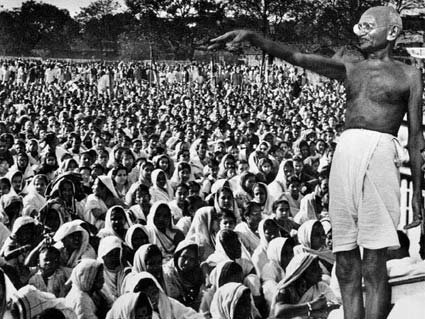
Congress in 1915, organized localized Satyagraha campaigns/non-violent struggles in Champaran (Bihar, Bengal
Presidency, 1917) and in Kheda (Gujarat, 1918) protesting against unfair heavy taxes on farmers and forceful indigo crop growing. Gandhi’s first large-scale, nationwide non-violent protest campaign was the Rowlatt Satyagraha, which ended in the Jallianwala Bagh massacre that killed more than 1000 peaceful protesters in Amritsar, Punjab, on April 13, 1919.
1940 to 1947: Major Events
This period was the most intense phase of India’s freedom struggle, involving World War II (1939-1945), INA attack, British-Indian military uprisings, and awakened nationalism. British rule in India came to an end, culminating in independence and the religion-based partition as demanded by the Muslim League. The major events, actions, and decisions over the previous 7 years from the date of independence, August 15, 1947, are summarized below.
1940:
Jinnah led the adoption of the Pakistan Resolution (Lahore, March 23) by the Muslim League, formally demanding a separate sovereign Muslim-majority country through partition.
Gandhi/Congress opposed unconditional participation of the Indian soldiers in World War II (1939-1945), but Jinnah /Muslim League supported the participation, expecting favorable terms for partition later. Gandhi acted on the basis of the bad experience from the post-World War I (1914-1918) situation, when Congress supported the participation of Indian soldiers, in exchange for getting Indian self-governance after the war. Gandhi felt betrayed as the British did not offer freedom after winning World War I, rather, the British passed the repressive Rowlatt Act in the Imperial Legislative Council in Delhi. Gandhi’s protests against the Rowlatt Act ended in the Jallianwala Bagh Massacre (1919).
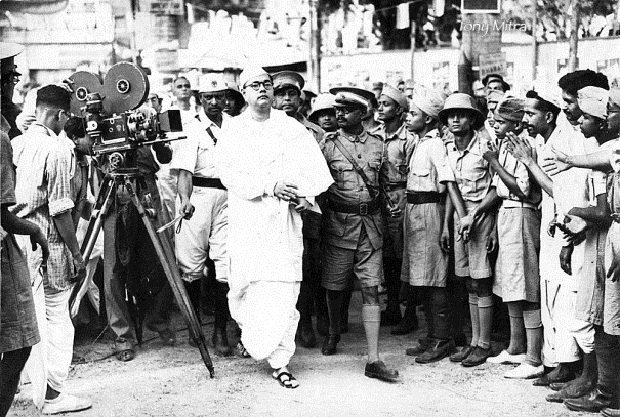
Bose held the 1st All India conference (Nagpur, June) of the Forward Block Party, which he founded after resigning from the position of re-elected Congress President (1939), due to ideological differences with Gandhi, ending 18 years of belief in the non-violence path. Bose used the new party platform to advocate for taking immediate advantage of Britain’s wartime vulnerability, pushing for an aggressive national struggle. The British colonial government arrested Bose and put him under house arrest (July).
The British Raj ignored the opinions of Indian political leaders and unilaterally declared that India was at War with Germany. The British recruited a volunteer force of over 2.5 million Indian soldiers—the largest volunteer army in history—who fought across the global fronts. Gandhi Satyagraha campaign gradually wound down.
The demand for freedom, through either non-violence or armed struggle, received the same fate of police arrests and judicial squash to uphold the supremacy of the British King. The ultimate strength of the British Raj was the British Indian military.
1941:
Bose escaped from his house arrest in Calcutta (January 16) and traveled through Afghanistan and the Soviet Union (Axis partner, till June 22, 1941) to reach Berlin, Germany, on April 2 to seek anti-British alliances. There he met with German foreign ministry officials and submitted a draft declaration for Indian independence, seeking a government-in-exile. Bose established the Free India Centre (Zentrale Freies Indien) which acted as a diplomatic and political mission for his provisional government.
Germany launched a surprise military invasion of the Soviet Union (June 22) ending the Germany-Soviet Union partnership built since August, 1939. The Soviet Union then signed the Anglo-Soviet Agreement (July 12) to become an Allied partner.
1942:
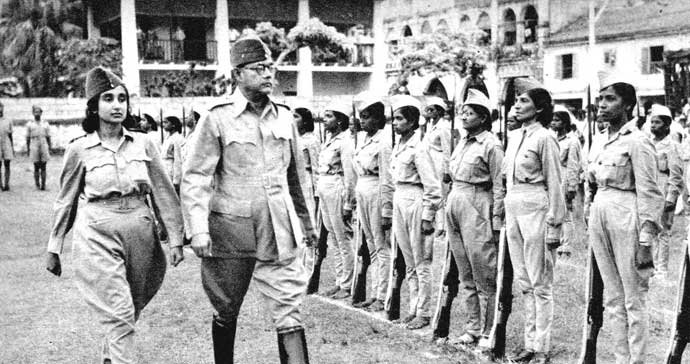
Bose in Berlin begins organizing the Indian Legion (Indische Legion) using Indian prisoners of war (POWs) captured in North Africa. “Netaji” the honorific title was first widely applied to Bose by Indian volunteers and German officials. He established Azad Hind Radio in Berlin (February) and started broadcasting anti-British messages to inspire resistance against British colonial rule.
British UK authorities sent a mission to India, under Sir Stafford Cripps, offering post-war Dominion status. But, Gandhi/Congress rejected the proposal because control of defense was to remain under the British authority. The Muslim League opposed the plan because it did not explicitly guarantee the creation of Pakistan (March).
Bose meets face-to-face with Adolf Hitler (May 29). Hitler remains non-committal about a public declaration on Indian independence, prompting Bose to look toward Japan for military partnership. Bose raised the issue of his secured journey to Japan to which Hitler agreed. Hitler promised to provide logistical support to travel by submarine.
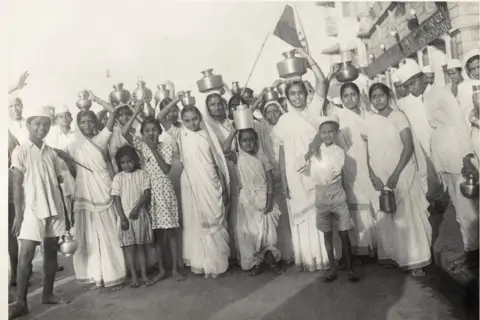
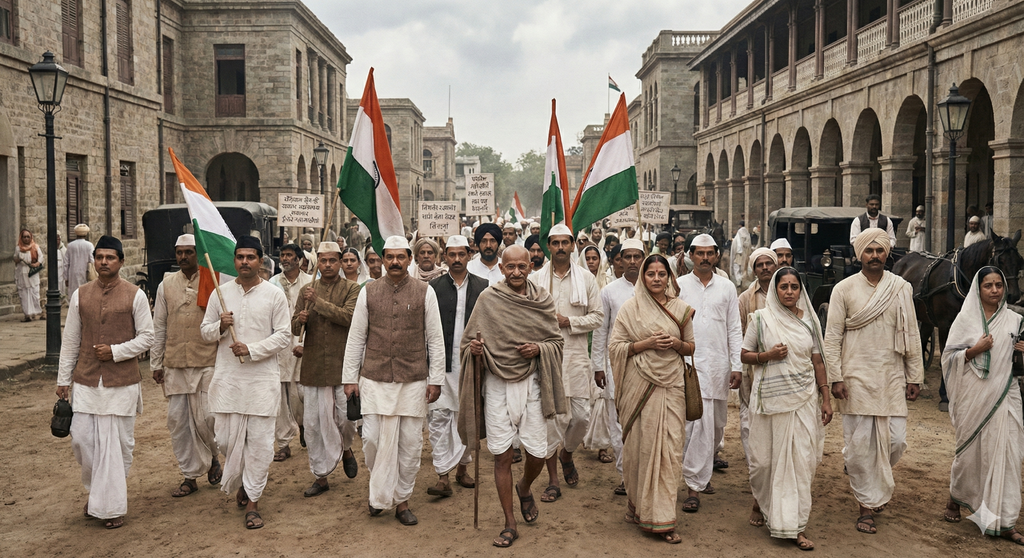
Gandhi began the ‘Quit India’ movement in August, after planning from April to July, but the British Raj quickly put all top leaders (Gandhi, Nehru) in jail. The Congress/Socialist leaders like Jaiprakash Narayan and Aruna (Ganguly), and Asaf Ali went underground. Students, the working population, and young men took initiative, created massive unrest, and attacked government establishments. Gandhi announced a call for do or die (karenge ya marenge). The movement had impacts in many areas like Satara, Medinipur, Ballia, and Surat. Over 100,000 arrests were made and many civilians were killed in police firing. In Medinipur, the movement was crushed violently and ruthlessly. Police opened fire on a satyagrahi procession that killed Matangini Hazra (1870-1942) on September 29.
Bose unconditionally supported the Gandhian movement and broadcast from Berlin the detailed instructions to the insurgents on how to keep the movement going. He also sent out a message to the Bangkok conference of Indian Nationalist leaders in the Far East to link the Indian Nationalists across the world.
Muslim League stayed away from the ‘Quit India’ movement.
The ‘Quit India’ movement petered out by March next year (1943).
1943:
Bose made his final public appearance in Berlin, celebrating Indian Independence (Purna Swaraj, 1930, Congress) Declaration Day on January 26. Bose hosted a notable event at the Kaiserhof Hotel in Berlin. Attendees included international figures like the Grand Mufti of Jerusalem and the former Prime Minister of Iraq.
Bose, on the way to Japan, departed from the German port of Kiel on a German U-180 submarine, beginning a perilous voyage to Japanese-controlled waters (February 8). In a risky mid-ocean operation, off the coast of Madagascar in the Indian Ocean, Bose was transferred from the German U-boat to a Japanese I-29 submarine (April 28). The Japanese submarine docked safely at Sabang, an island off Sumatra, where Bose rested for a few days (May 6). Bose boarded a Japanese aircraft and completed his transit into Japanese command, checking into the Imperial Hotel in Tokyo under the alias Matsuda (May 11).
In the meantime, in Japan, Rash Behari Bose (1886-1945), the revolutionary leader associated with the Ghadar mutiny (1913-1915) during World War I, founded the Indian Independence League to continue to fight the British Raj (March). He fled to Japan in 1915 after the pan-India armed mutiny plan failed because of a leak through a British intelligence mole.
As to the Ghadar mutiny event, it was a globally networked revolutionary campaign launched by the expatriate Indian diaspora, mostly Punjabi workers in North America (Yugantar Ashram, San Francisco), to militarily overthrow the British Raj in India. The Ghadar (a Punjabi word meaning revolt) Party, established in 1913 by leaders like Sohan Singh Bhakna and Lala Hardayal, used to publish the Ghadar weekly (in Punjabi, Urdu) bearing the masthead Enemy of the British Rule (Angrezi Raj Ka Dushman). To take advantage of Britain’s difficulties during World War I, thousands of Ghadarites returned to India, attempted to smuggle arms, and sought to receive financial/military aid from Germany and Japan to spark a mutiny among the British-Indian military personnel. A planned general mutiny for February 21, 1915, was betrayed from within. The British crushed the localized uprisings in Punjab, leading to the trial of the Lahore Conspiracy Case. Ghadar ideals shaped later revolutionaries like Bhagat Singh. In a sense, what Subhash Bose tried during World War II was attempted by Rash Behari Bose and associated revolutionaries during World War I, some 27 years before.
Bose held his first historic meeting with Japanese Prime Minister Hideki Tojo and secured a promise of unconditional support for Indian independence (June 10). He held his second major consultation with PM Tojo, finalizing mutual terms regarding the independence of the Indian army from Japanese control (June 14). Bose attended the extraordinary session of the Japanese Imperial Diet/ Parliament (June 16). Bose addressed a major international press conference in Tokyo, declaring that the British must permanently leave India (June 19).
Subhas Chandra Bose traveled to Singapore and received the handover of the leadership of the Indian Independence Movement in East Asia and of the Indian National Army (INA, Azad Hind Fauj) from Rash Behari Bose (July 4, 1943). Bose proclaimed the Provisional Government of Free India (Arzi Hukumat-e-Azad Hind) in Cathay Theater, Singapore, under Japanese control (October 21). Acting as the Head of State, Prime Minister, and Minister for War. The Free India Govt. established the National Bank of Azad Hind, minted its own currency, and used the greeting “Jai Hind”. Bose rallied the INA to launch an armed struggle for India’s independence from British Raj. The Free India government received diplomatic recognition from nine countries, including Japan, Germany, and Italy.
Netaji traveled back to Tokyo for the Greater East Asia Conference, where PM Tojo announced the transfer of the Andaman and Nicobar Islands, captured by Japan in 1942, to the Provisional Government of Free India (November).
Netaji traveled to the Andaman Islands and hoisted the Indian National Flag (Tricolor) for the first time on Indian land, at the Gymkhana Ground, Port Blair (December 30). He declared the Andaman and Nicobar Islands as a liberated territory of the Azad Hind government. He symbolically renamed the Andaman Island as Shaheed Dweep (Martyr Island) and the Nicobar Island as Swaraj Dweep (Self-rule Island).
The Bengal famine (1943-1944), which killed an estimated 2 to 3 million people in Bengal and surrounding regions, happened as the British Raj continued to export food overseas. British PM Churchill dismissed Indian suffering, attributed the crisis to local overpopulation, and disgracefully commented, “breeding like rabbits”.
1944:
Netaji transferred the headquarters of the Provisional Government and the INA from Singapore to Rangoon (Yangon), Burma, to direct the military operations closer to the Indian border (January). The INA’s Subhas Brigade and Japanese forces initiated the “U-Go” offensive, crossing the Burma border to launch a direct assault on British positions in Assam and Manipur. INA troops officially crossed the frontier and set foot on mainland Indian soil (March). INA’s Col. Shauket Ali Malik hoisted the Indian tricolor flag for the first time on liberated mainland Indian soil in Moirang, Manipur (April 14; 1944; Observed annually as INA Flag Hoisting Day).
Netaji broadcast a speech on Azad Hind Radio addressing Gandhi as the “Father of the Nation” for the first time, asking for his blessings in the “holy war” for India’s freedom. Intense fighting occurred during the Battle of Kohima and Imphal.
Severe monsoon weather, collapsing Japanese supply lines, and heavy allied counter-attacks halted the offensive (AprilJune). The offensive failed, and the INA suffered massive casualties from starvation, disease, and combat, forcing a messy strategic retreat back through Burma (August-December).
Gandhi was released from prison due to failing health (June). Gandhi and Jinnah held direct talks but produced no results over conflicting interpretations of a future independent country framework.
1945:
Netaji oversaw the defense and subsequent evacuation of INA and Azad Hind government infrastructure from Rangoon, under intense pressure from advancing British Fourteenth Army forces (Jan-March). As Allied forces recaptured key Burmese territories, INA forces retreated toward Bangkok, Thailand, maintaining morale through radio addresses and reorganizing remaining personnel.
Germany surrendered unconditionally to the Allied forces (May 7; May 8 Victory Day).
The general military position of the Axis collapsed in Southeast Asia; INA refused to surrender unconditionally early on, seeking alternative diplomatic maneuvers (June).
Clement Attlee took charge as the Prime Minister of the United Kingdom after leading the Labor Party to a landslide election victory and succeeding Winston Churchill (July 26, 1945).
Japan announced its surrender to the Allied powers on August 15, and that effectively ended the active military phase of the INA. Once again, the hope of sparking a mutiny among British-Indian soldiers was not realized.
Netaji addressed his troops and supporters via a final radio broadcast in Singapore on August 15, 1945. Netaji escaped for the 2nd time on August 18, 1945, per the Justice Mukherjee Commission of Inquiry and Report (2005), which was not accepted by PM Manmohan Singh’s Congress government. INA POWs were brought to Delhi, India.
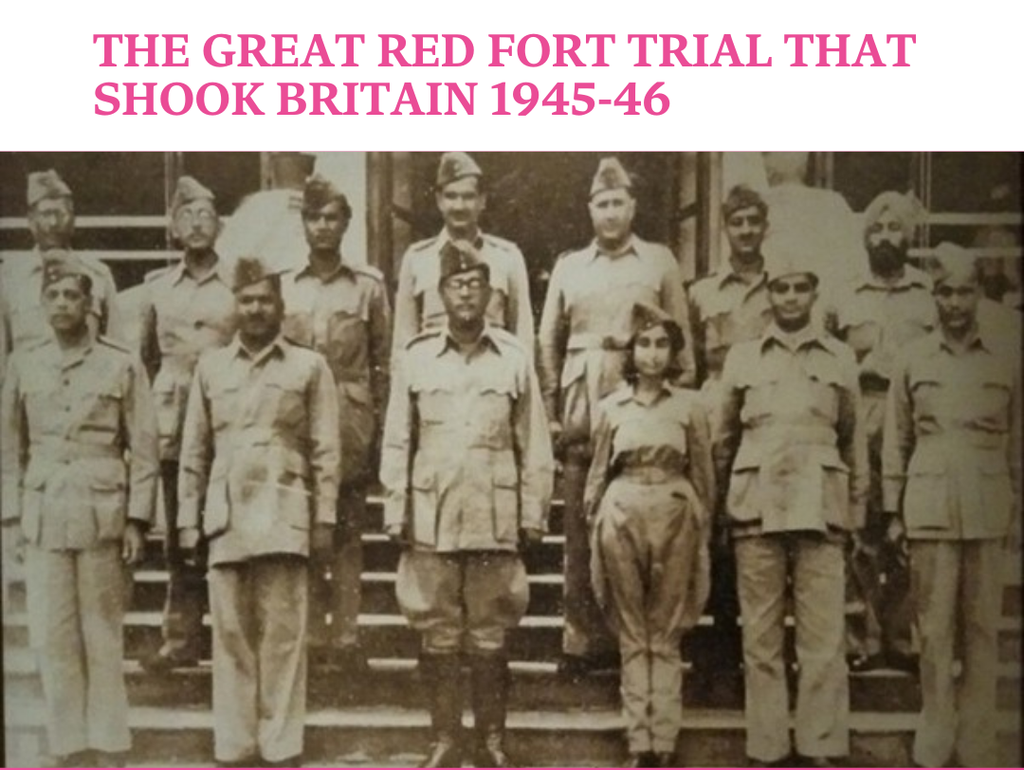
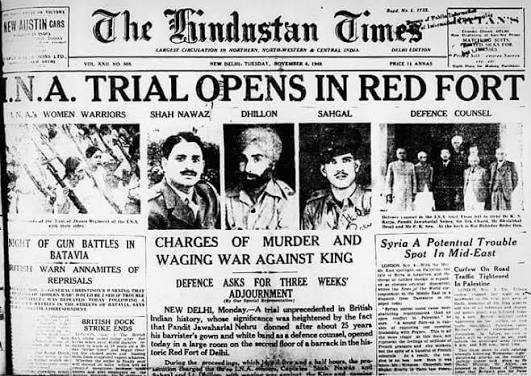
British Raj, intending to continue their colonial rule, wanted to reassert their authority/supremacy by sending an absolute warning to the British-Indian soldiers, as they did during the post-Sepoy Mutiny trial of 1857-1858. To control the narrative of a free British imperial law, they intended to use the legal system as a theater for a public, high-profile Red Fort (Delhi) trial of the top POWs representing three major religious groups, namely Shah Nawaz Khan (Muslim), Prem Sahgal (Hindu), and Gurbaksh Singh Dhillon (Sikh) (November 5).
The charges against the POWs were waging war against the British Crown, murder, and abetment. Bhulabhai Desai was the brilliant leading counsel who delivered the main, historic defense arguments. Desai argued that an enslaved nation has the legal right to fight for its freedom. The defense maintained that the INA was the organized army of a provisional government, making them legitimate POWs, not traitors. They argued British domestic treason laws could not apply to soldiers fighting under a foreign, sovereign provisional state.
The INA POW trial backfired for the British. They arrogantly confined the POWs in makeshift enclosures, often referred to as POW cages. These visible enclosures in and around Delhi sparked intense public fury and widespread nationalist protests across India. Lifting wartime censorship allowed Indian newspapers to print daily saturation coverage of the defense’s blistering anti-colonial arguments, turning the courtroom into a massive nationalist stage.
The court found the first three officers guilty of “waging war against the King-Emperor” (December 31, 1945).
1946:
Public protests continued throughout India, particularly in Calcutta, Delhi and Bombay, as the trials transformed the accused soldiers into national heroes, sparking massive public rallies, student strikes, and clashes with police.
Salil Chowdhury, then a young student, participated in the anti-British protests and composed his first poem/song as,
“Bicharpoti tomar bichar korbe jara aj jegeche ei Jonota.”, condemning the public trial as a farce intended to scare the public.
The British quickly realized that prosecuting these men had broken the “load-bearing column” of their empire—the absolute loyalty of the indigenous British Indian Army. Intelligence reports showed that Indian soldiers and veterans intensely sympathized with the INA POWs.
Fearing a nationwide mutiny, Claude Auchinleck, Commander-in-Chief of the Indian Army, was forced to commute the judicial sentences awarded against officers of the INA in the face of the growing unease and unrest both within the Indian population and in the British Indian Army. All subsequent trials were dropped as well (January).
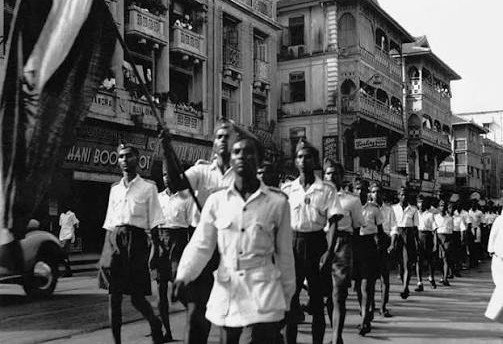
As feared by the British, Indian Public anger reached the British Indian war-hardened troops, who were more than a million in number. The British had limited troops (5 white divisions, roughly 100 thousand in number) stationed in India. Also, they were war-weary, tired, and were ready to go home after war deployment.
British Indian military forces, Army, Navy and Air Force, started protesting against the discrimination they faced from the British authorities. The British Indian Air Force refused to service the aircraft spread across nearly 60 RAF and regional air stations in India, Ceylon, and Burma (early February).
Naval Mutiny by Royal Indian Navy (RIN) occurred when ratings (sailors) at the HMIS Talwar shore establishment in Bombay went on a “No Food, No Work” strike. The revolt, protesting racial discrimination and British colonial rule, quickly spread to thousands of sailors across a significant number of ships and multiple shore bases in India (Feb. 1723).
Timeline of the Naval Mutiny (February 1946)
- February 17: Ratings at Castle Barracks and HMIS Talwar in Bombay protested via a hunger strike following an aggressive pushback from commanding officers.
- February 18: The formal mutiny erupted as HMIS Talwar ratings took control, spreading quickly to Castle Barracks and other local units.
- February 19: The mutiny went nationwide. 20,000 Sailors on roughly 60–78 ships in Bombay, Karachi (HMIS Hindustan), Madras (HMIS Adyar), and Vizag joined the strike.
***British PM Clement Attlee announces the Cabinet Mission initiative.
- February 20–22: A massive general strike paralyzed Bombay. Street fighting and clashes occurred between British forces and local crowds, while Royal Navy warships and RAF planes moved into position. Fierce armed battles took place in Karachi between British troops and the crew of HMIS Hindustan until ammunition ran low.
*PM Atlee Attlee officially started updating the British Parliament on the mutiny, starting on Feb. 22, 1946.
- February 23: Following urgent appeals and intervention by political leaders like Sardar Patel/Congress and Jinnah/Muslim League, the central strike committee surrendered unconditionally, bringing an end to the active insurrection.
The mutiny is described in detail by the protagonist Balai Chandra Dutt, who was a sailor himself in the HMIS Talwar, in his autobiographical book Mutiny of the Innocents. Dutt played a crucial role in the Naval Mutiny, using his revolutionary zeal and leadership to mobilize the sailors and support the protests. This event is termed as the “Last War of
Independence” by the author Pramod Kapoor. Also, the British Indian Army / Indian Signal Corps (1700+) protests took place at Jabalpur (Feb. 27).
Gandhi opposed the Naval Mutiny and gave a press statement (Poona, 23-2-’46; Harijan, 3-3-1946) as (excerpts),
“This mutiny in the Navy and what is following is not, in any sense of the term, non-violent action.
Burning of tramcars and other property, insulting and injuring Europeans, is not non-violence of the Congress type, much less mine, if and in so far as it may be different from the Congress.”
Other Congress/Socialist/Communist leaders, including Aruna (Ganguly) Asaf Ali, supported the Naval Mutiny.
Gandhi Commented on fellow Congresswoman Aruna (Poona, 26-2-’46, Harijan, 3-3-1946) as (excerpts),
“I congratulate Shrimati Aruna Asaf Ali on her courageous refutation of my statement on the happenings in Bombay.
She is entitled to say that the people ‘are not interested in the ethics of violence or non-violence, but the people are very much interested in knowing the way which will bring freedom to the masses – violence or non-violence. The people have, however imperfectly, hitherto gone the way of non-violence.”
British authorities might have thought about a 2nd 1857 Sepoy Mutiny. Viceroy Wavell felt concerned for 90,000 Europeans in India.
A Cabinet mission to India, consisting of Lord Pethick-Lawrence, Sir Stafford Cripps, and A.V. Alexander, while announced on February 19, arrived in India on March 24, 1946. The mission goal was to negotiate a peaceful transfer of power. That was the beginning of the end of the Indian freedom struggle.
1947:
British Prime Minister Clement Attlee announced the formal decision to leave India on February 20, 1947, declaring that power would be transferred by June 1948 at the latest. King George VI later gave royal assent to the final Indian Independence Act 1947 on July 18, 1947, cementing the final withdrawal date of August 15, 1947.
Epilogue
Analyzing from military and economic perspective, early British rule used the tax money from India to buy Indian goods and then ship them to Britain without any additional costs. India bought lots of cheap factory goods made in Britain. Britain used the large Indian Army to fight wars across Asia and Africa at no cost to British taxpayers. However, after
World War II, its own economy got ruined. British debt after the war reached 250% of GDP, and the British currency, the pound, lost its Reserve Currency status to the US Dollar in 1944. Keeping a large military presence and maintaining control became too expensive after the war. Trade with India mattered less to the recovering British economy than trade with Western nations. The future profitability of India as a colony became questionable.
INA’s own candid and thought-provoking reflection is expressed on the Moirang, Manipur, INA museum wall as,
“Despite the Military defeat, the INA’s contribution to India’s independence movement was immense. The Red Fort Trials of Ex-INAs in Delhi from November 1945 to May 1946 generated a massive wave of sympathy and patriotic fervor across India, uniting people from all communities. The widespread public support for the INA and the discontent it created among Indian soldiers in the British Indian Army played a significant role in weakening British authority in India.
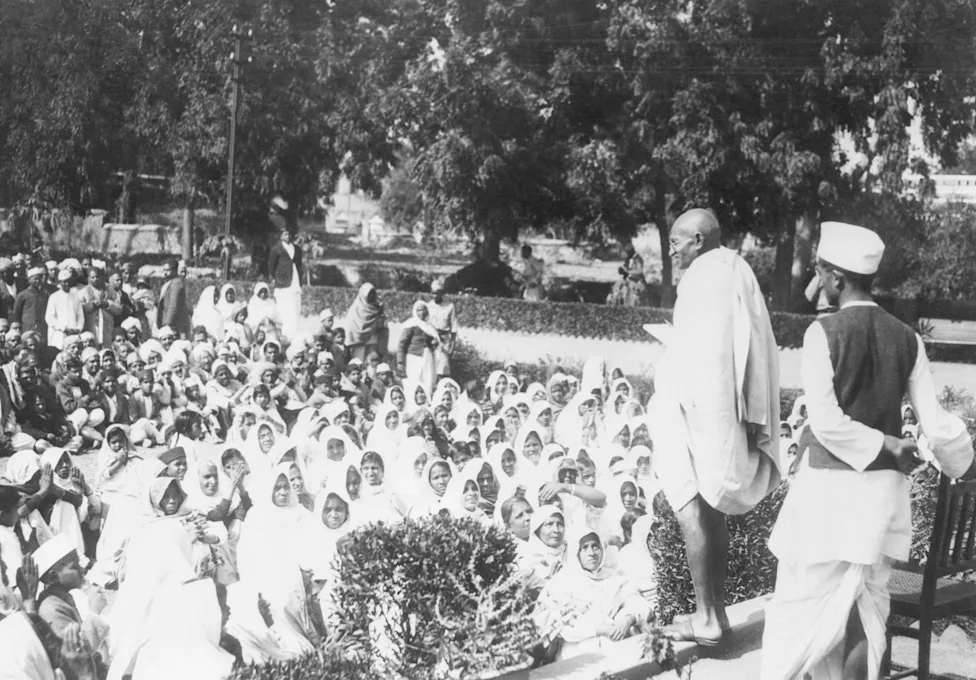
The INA under Subhas Chandra Bose thus became more than just a military organization- it evolved into a symbol of courage, unity, and sacrifice. Though it did not achieve its immediate goal of liberating India by force, it awakened a new spirit of nationalism that hastened the end of British rule.”
The INA trial backfired on British authorities. Though the British suppressed the 1946 Naval Mutiny, the revolutionaries were successful in inducing fear in the minds of the British authorities. Those events marked a profound turning point that signaled a new realization for the British imperialists that they could no longer fully rely on the loyalty of the British Indian Army. That aspect has been missing in all the previous struggles, armed or non-violent. British authorities managed all the pre-1946 challenges because the British Indian military was always loyal to them. Unfortunately, this type of comprehensive perspective of the freedom struggle is not taught in Indian history books.
As Clement Attlee, the British PM at the time of independence, later acknowledged, the severe dent the INA trials made in the loyalty of the Indian military was a primary factor that forced the British to rapidly plan their exit from India. Justice P.B. Chakravartti, former Acting Governor of WB and Chief Justice of the Calcutta High Court, met with PM Atlee in 1956, according to unconfirmed media sources.
Therefore, the trigger for the decision of the British imperialists to leave India was most likely the feeling of uncertain loyalty of British Indian soldiers following the INA POW trial and the 1946 Naval Mutiny events, and the awakened public spirit of nationalism.
References:
- Mutiny of the Innocents, B. C. Dutt, 1971, (Revised edition 2015).
- 1946: Last War of Independence, Royal Indian Navy Mutiny; Pramod Kapoor, 2022.
- Report of the Justice Mukherjee Commission of Inquiry on the alleged disappearance of Netaji Subhas Chandra Bose, Volume II B, 2005,
- Gandhi: Press Statements 1946; https://www.mkgandhi.org/mynonviolence/chap82.php